The product (Wave, you’re indexed!)
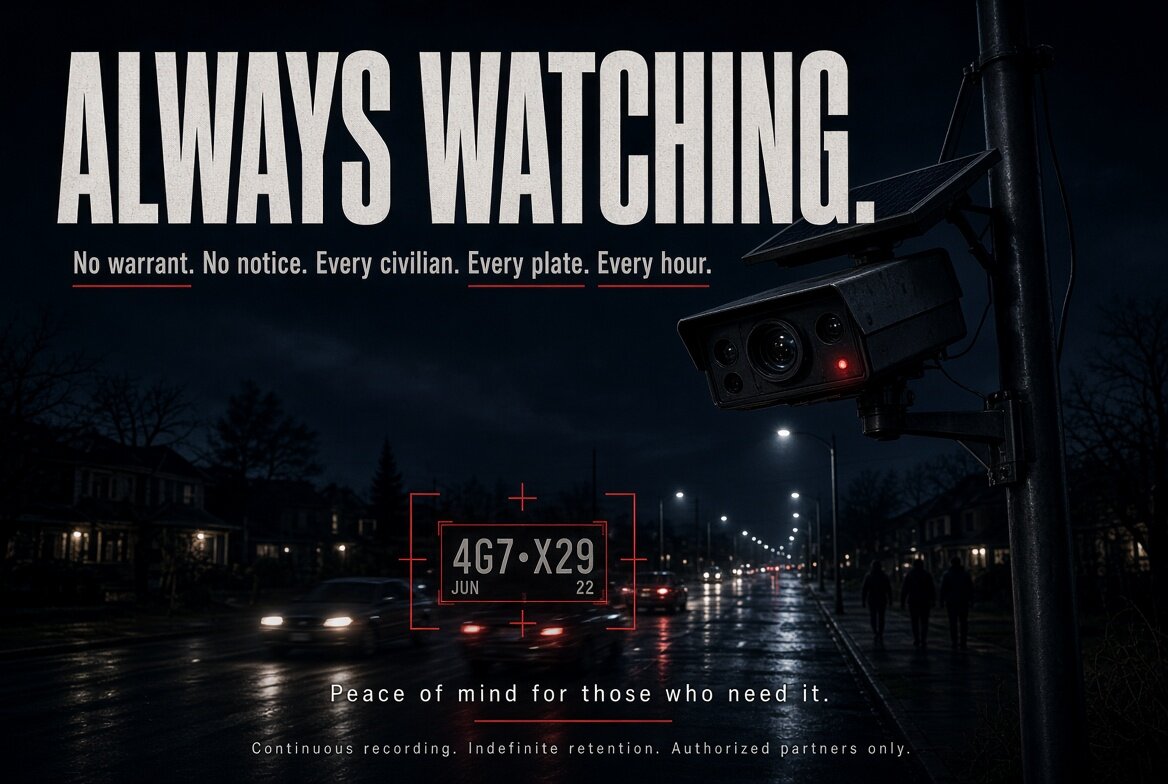
Flock Cameras in Your Neighbourhood is a mesh of cellular-connected, solar-powered AI cameras — we call each unit a Perch™ — that bolts to any light pole in eleven minutes with no wiring, no trenching, and, in most municipalities, no public hearing anyone attended. Each Perch watches. All of them remember. Together, they are a flock, and the flock feeds one thing: The Rookery™, an AI-searchable database of everything everyone in your city is doing, at all times, retained indefinitely, indexed by face, plate, gait, and vibe.
- Perch™ hardware — solar, LTE, self-updating, pigeon-resistant. Installs so quietly that in pilot testing, the crew that mounted them could not later find them. The Rookery found them in 0.8 seconds.
- EverySight™ recognition — identifies 40,000 distinct human activities and scores each for suspicion. Walking briskly: 7/10. Standing still: 9/10. There is no activity that scores zero. Our behavioral team tried “helping an elderly neighbor with groceries” and the model returned 4/10, subcategory: casing.
- Plain-English search — no training required. Type “everyone who visited a pawn shop twice in March” and get faces, timestamps, and home-address inferences before you finish your coffee. The demo query autocompleted. Think about that.
- The Open Marketplace — law enforcement dashboards and the corporate API read the same live database, same day, same pricing page. Current waitlist: 41 insurers, 12 landlord groups, 3 loss-prevention consortiums, and one HOA whose application is pending and, frankly, alarming in its enthusiasm.
- Zero-warrant architecture — the footage is technically ours, so asking for it is technically shopping. Our counsel wrote this sentence, read it back, and took the rest of the week off.
- FlightPath™ (beta) — predictive movement modeling. The flock doesn’t just know where everyone is. It has an opinion about where you’re statistically about to be, and it sells that opinion by the query.
The Rookery console, live from the pilot. The trumpet really is indexed. There is a table for objects. Nobody asked for the objects table.
Why it will absolutely work (attendance was low)
Here is how a city buys total surveillance: it appears as item 14(c) on a Tuesday procurement agenda, after the fountain repair, described as “pole-mounted public-safety analytics units.” Attendance that night is nine people, and four of them are there about the fountain. The grant money is federal, the pitch is “solve crimes faster,” and the contract is signed before anyone reads the part where the same database has a corporate pricing page. It only takes one sparsely attended council meeting. Have you ever attended one? Exactly. Neither has your neighbor — and unlike you, his doorbell camera has already applied to join the flock.
“For fourteen years I tracked people between websites and they called me a genius. The street was the last place without a tracking pixel. That bothered me professionally. It doesn’t have to bother me anymore — that part’s up to you, and it costs $200,000.” — Vaughn Kestrel, closing slide of the pitch deck, which he presents unprompted
And the economics are obscene, even by this platform’s standards: the city pays for the poles, the public pays for the grant, and then corporations pay us again to search what the cameras saw. We sell the same glance three times. Our CFO calls it “triple-dipping.” Our CFO is not allowed to speak at conferences anymore.
What happens if you don’t stop us
- Launch month — Three pilot cities go live2,000 Perches. You will not be told which cities. That’s the pilot’s control variable: you.
- One quarter later — Retail tier“Loss prevention” expands to mean everyone who ever returned an item, browsed without buying, or read a price tag with visible skepticism.
- Two quarters later — HomeRoost™Private doorbell cameras join the flock voluntarily, one terms-of-service update at a time. Your neighbor’s porch becomes our stringer. He gets a $4 credit. He will take the $4.
- Within two years — FlightPath™ general releaseThe database stops describing the past. Insurers adjust your premium for places you are statistically about to go. You haven’t decided yet. The flock has.
Why you should buy us out of existence
You will never be offered this product. Your city council is the customer. Your police department is the customer. The mall, the insurer, the landlord — customers. You are the inventory. There is no opt-out checkbox on a light pole, no cancel button on a sidewalk, and no version of “voting with your wallet” available to you at any register in town — except this one. This page is the only place on Earth where the person being watched gets a pricing tier.
Reach $200,000 and the wind-down is total and, we think, beautiful: The Rookery is deleted under third-party supervision, the 214 pilot units are de-lensed and rebuilt into numbered cedar birdhouses — the only flock any city needs — and the corporate waitlist receives a one-line email: “The public outbid you.” Vaughn retrains as a wildlife photographer. He will still watch things all day. The things will be herons. Everyone agrees this is growth.
Meet the anti-founder
Vaughn Kestrel spent fourteen years in advertising technology, where he invented the tracking pixel that follows you between devices and the consent banner where “Reject All” takes four clicks and “Accept” is the size of a door. He pivoted to “civic analytics” after realizing that outdoors, unlike the internet, has no ad blocker, no incognito mode, and no bedtime.
He listed on KickStopper, he says, as a matter of professional honesty: “Every city will eventually buy something like this from somebody. I’m the only vendor honest enough to let you outbid them first. That’s not a threat — it’s a limited-time offer, and unlike my cameras, it expires.”
Risks and challenges
The hardware ships from the same factories as everyone else’s cameras. The model is trained. The pilot parking lot has, in eight weeks, become the most thoroughly understood parking lot in human history. Three city procurement offices have the paperwork drafted, and government paperwork, once drafted, has a survival instinct.
$25,694 to go. The flock can wait on the wire. The question is whether you can.
I’m a privacy attorney. I have argued against systems like this for a decade using briefs, and it has gone about how you’d expect. Today I tried money instead. $500. This platform is the first legal instrument in years that felt load-bearing.